HAF Free Holiday Clubs: Who Qualifies After the Free School Meals Expansion (2026)
KEY TAKEAWAYS
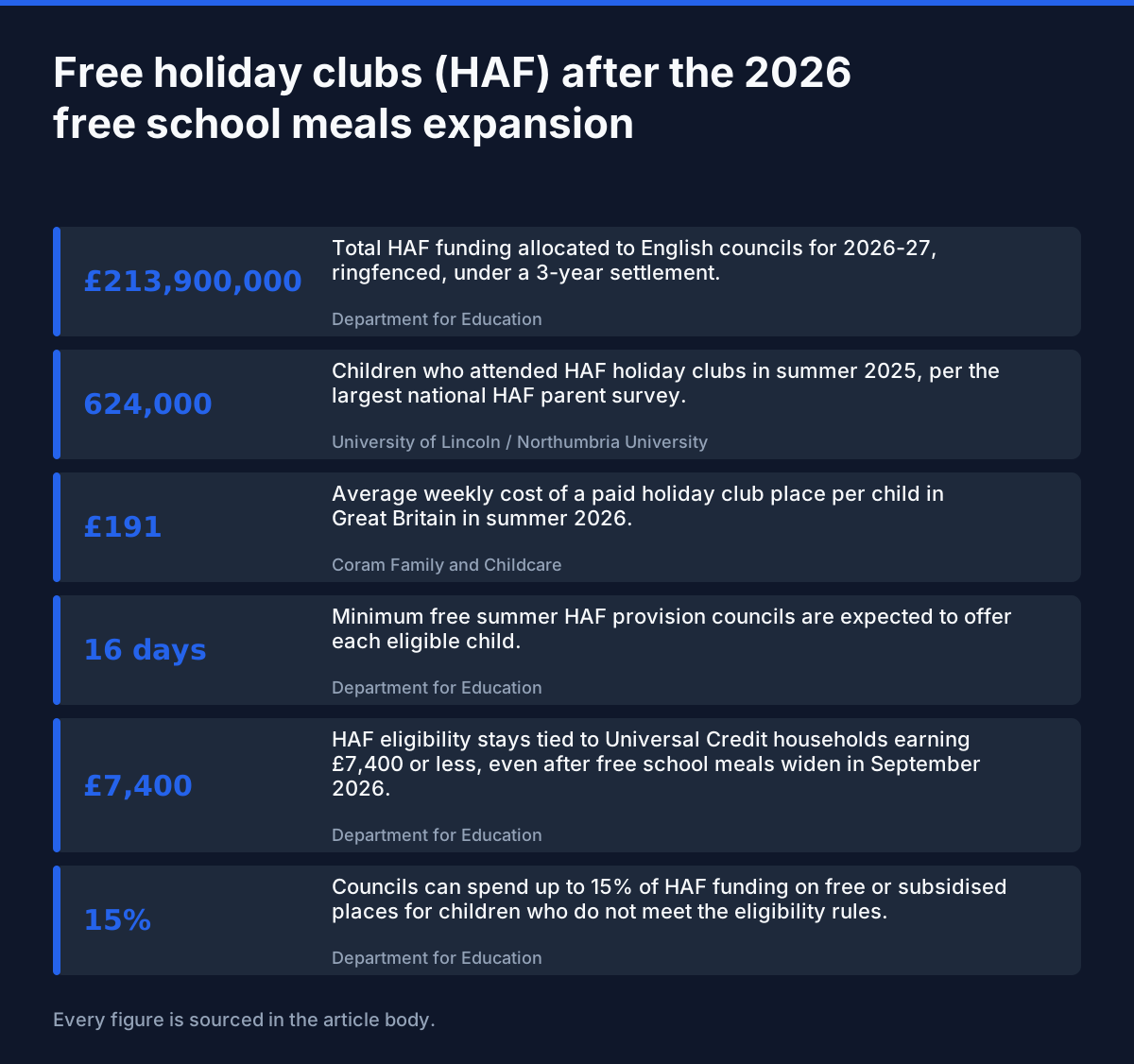
- → £213,900,000 Total HAF funding allocated to English councils for 2026-27, ringfenced, under a 3-year settlement. (Department for Education, 2026)
- → 624,000 Children who attended HAF holiday clubs in summer 2025, per the largest national HAF parent survey. (University of Lincoln / Northumbria University, 2025)
- → £191 Average weekly cost of a paid holiday club place per child in Great Britain in summer 2026. (Coram Family and Childcare, 2026)
- → 16 days Minimum free summer HAF provision councils are expected to offer each eligible child. (Department for Education, 2026)
- → £7,400 HAF eligibility stays tied to Universal Credit households earning £7,400 or less, even after free school meals widen in September 2026. (Department for Education, 2026)
- → 15% Councils can spend up to 15% of HAF funding on free or subsidised places for children who do not meet the eligibility rules. (Department for Education, 2026)
- → £4,478,640 Lancashire County Council's HAF funding total for 2026-27. (Department for Education, 2026)

England's free school meals rules changed this September, and the change did not reach the school holidays. Every child in a Universal Credit household can now get a free lunch in term time, but the Holiday Activities and Food programme, known as HAF, still uses the old, stricter test. Feeding Britain estimates that around 500,000 children will get free meals at school yet have no right to a free holiday club place (Feeding Britain, 2026).
That gap matters most to the families it lands on: working parents on Universal Credit who earn just enough to sit above the old line. They now see their child fed at school, assume the holiday offer follows, and find it does not. This page sets out, from the Department for Education's own guidance and allocations, exactly who still qualifies, what a free place includes, how much money each area has, how many children actually use it, and what the families outside it pay and can claim back.
Every figure below links to its source. Where a number comes from a campaign group or a self-reported survey rather than official statistics, the text says so.
1 Who Qualifies for a Free HAF Holiday Club From September 2026?
A child qualifies if they are in reception to year 11 and receive targeted free school meals: a Universal Credit household with earnings of £7,400 or less a year after tax (Department for Education, 2026). The wider free school meals group created in September 2026 is not included, although councils can use up to 15% of their funding for other children.
| METRIC | VALUE | SOURCE |
|---|---|---|
| Household earnings limit for HAF | £7,400 | Department for Education |
| School years covered | reception to year 11 | Department for Education |
| Extra children getting free school meals from Sept 2026 | half a million | Department for Education |
| Pupils eligible for free school meals, 2025/26 | 2.2 million | Department for Education |
| Share of pupils eligible, 2025/26 | 26.5% | Department for Education |
| Discretionary share of HAF funding | 15% | Department for Education |
From September 2026 there are two kinds of benefits-based free school meals. Targeted free school meals use the long-standing test of household earnings at or under the limit. Expanded free school meals cover every other Universal Credit household. The DfE's 2026-27 guidance states that HAF eligibility will remain aligned to the targeted group and will not extend to all Universal Credit households (Department for Education, 2026). The government's announcement of the free meals expansion put the number of newly covered children at over half a million (Department for Education, 2025), which is the same group the campaign figure describes.
The guidance also names a group that may lose out: children who had kept free meals through transitional protection, which ended this summer. If their family's circumstances no longer meet the targeted test, they may no longer get a HAF place from the autumn. Universal infant free school meals, the lunch every reception, year 1 and year 2 pupil gets, never counted towards HAF, and still does not.
Context on scale: 26.5% of pupils in England, more than 2.2 million children, were already eligible for free school meals before the expansion (Department for Education, 2025). If you are unsure which group your child is in, your school office can tell you which category your child is recorded under, and our frequently asked questions cover how our own clubs handle bookings.
2 Can Children on the New Free School Meals Still Get a Free Holiday Place?
Not by right, but often by asking. Councils may spend up to 15% of their HAF money on free or subsidised places for any school-age child they think would benefit, without asking the DfE first (Department for Education, 2026). Families just above the earnings line should contact their council's HAF team and their holiday club directly.
| METRIC | VALUE | SOURCE |
|---|---|---|
| Children excluded from HAF despite term-time free meals (estimate) | 500,000 | Feeding Britain |
| Council discretion for non-eligible children | 15% | Department for Education |
| Tax-Free Childcare top-up, maximum per child per year | £2,000 | HM Government (GOV.UK) |
| Childcare costs Universal Credit can pay back | 85% | HM Government (GOV.UK) |
This is the question nobody seems to be answering for parents. The flexible share exists because councils know their own areas, and it is the main route for a working family who has just moved into the expanded free meals group. It is limited, and it is set locally, so the answer differs between, say, Lancashire and Blackburn with Darwen. Ask early: places are usually allocated before each holiday opens for booking.
Feeding Britain's case, published in August, is that a child who needs support in term time still needs it when school closes, and that running two eligibility lists will make every club recheck families who attended before (Feeding Britain, 2026). One provider quoted in that piece describes it as the tail wagging the dog. The DfE's position is set out in its guidance rather than argued: funding is fixed for three years, and widening eligibility without extra money would spread the same days across more children.
If a free place is not available, the cost of a paid club can still be cut. Tax-Free Childcare adds £2 for every £8 you pay, up to £2,000 per child each year (HM Government (GOV.UK), 2026), and Universal Credit can repay up to 85% of childcare costs (HM Government (GOV.UK), 2026). Both work only with registered providers, so check before you book. Our team can tell you which of our clubs accept them.
3 How Much HAF Money Does Each Area Get in 2026-27? Lancashire Has £4.48m
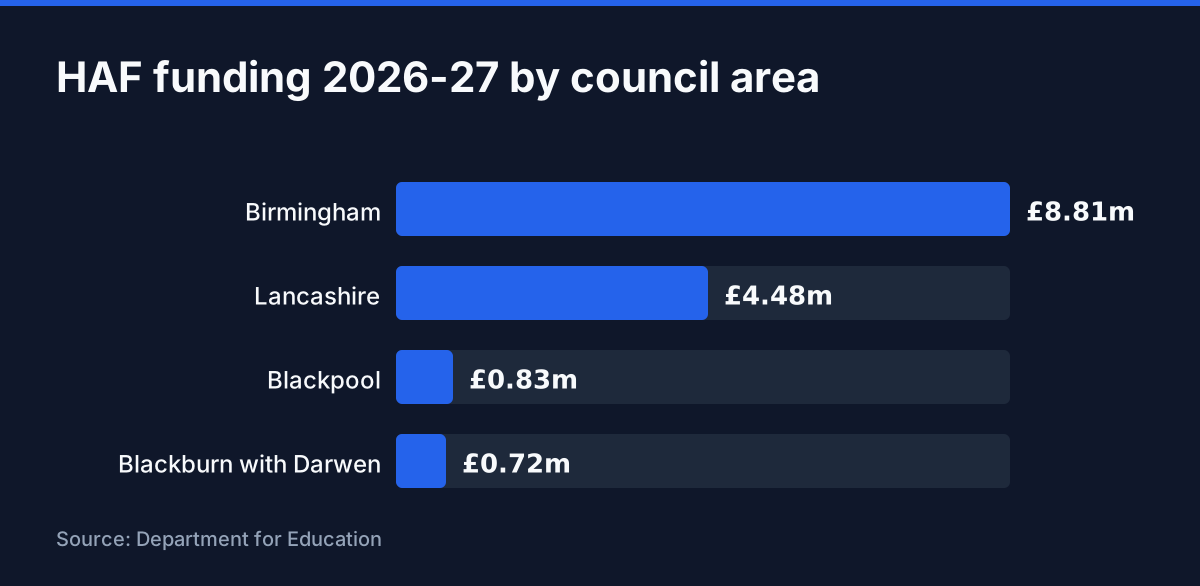
Councils in England share £213,900,000 of HAF funding for 2026-27, of which £201,000,000 is expected programme and admin spend (Department for Education, 2026). Lancashire County Council's total is £4,478,640. The money is ringfenced and guaranteed until 2028 to 2029, the final year of the current settlement.
| METRIC | VALUE | SOURCE |
|---|---|---|
| Total HAF funding, England | £213,900,000 | Department for Education |
| Expected programme and admin spend | £201,000,000 | Department for Education |
| Council capacity funding for school-age childcare | £12,900,000 | Department for Education |
| Lancashire | £4,478,640 | Department for Education |
| Blackpool | £827,140 | Department for Education |
| Blackburn with Darwen | £723,500 | Department for Education |
| Birmingham (largest single allocation) | £8,806,290 | Department for Education |
| Admin allowance (was 10%) | 7.5% | Department for Education |
Allocations follow the number of eligible children in each council area, which is why Birmingham's £8,806,290 dwarfs most others (Department for Education, 2026). Blackpool and Blackburn with Darwen are unitary councils and run their own programmes, so a family in Darwen and a family in Pendle apply through different council teams even though they live a few miles apart.
Two smaller changes sit inside the 2026-27 figures. A new £12,900,000 pot gives councils capacity to plan school-age childcare more widely, including the rollout of free breakfast clubs, and in return the admin share councils can keep from HAF itself has dropped to 7.5% (Department for Education, 2026). The three-year settlement, confirmed in the guidance (Department for Education, 2026), means councils and community providers can plan summer 2027 and 2028 now rather than waiting for a yearly announcement, which is what campaigners and councils had asked for.
For Pendle families, the practical point is that Lancashire's HAF offer is commissioned out to local providers. Community organisations, including Harringtons, run holiday activities and clubs across Nelson and Brierfield, and our partners and funders include Lancashire County Council and Pendle Borough Council.
4 What Does a Free HAF Place Include? At Least 24 Days a Year
Councils are expected to offer each eligible child at least 24 days a year: 16 days in summer and 4 days each at Easter and Christmas (Department for Education, 2026). Sessions should run around 4 hours a day where practical and include a healthy meal, physical activity and an enrichment activity such as cooking, art or sport.
| METRIC | VALUE | SOURCE |
|---|---|---|
| Minimum provision across the year | 24 days | Department for Education |
| Minimum summer provision | 16 days | Department for Education |
| Minimum at Easter and at Christmas (each) | 4 days | Department for Education |
| Expected session length | 4 hours a day | Department for Education |
| Cap on half-term spending | 5% | Department for Education |
HAF is designed as food plus activity, not a lunch voucher. The guidance sets out the outcomes it wants: children eating healthy, nutritious meals, keeping physically active, having fun and making friends, and learning more about food and nutrition (Department for Education, 2025). For secondary-age children, councils can run shorter sessions spread over more weeks, because teenagers are less likely to attend a full day. If you have an older child, look for teenage-specific provision such as our 11-16 holiday activities.
Councils may also run HAF in February, May or October half-term, but that can take no more than 5% of their allocation (Department for Education, 2026), so half-term places are scarce. Many families fill the gap with a mix of paid clubs and free activity sessions. For younger children, our Fun Vibes holiday club registration covers Brierfield and Nelson.
5 How Many Children Actually Use HAF? 624,000 Last Summer
More than 624,000 children attended HAF in summer 2025, according to a national survey of 20,000 families across 50 council areas (University of Lincoln / Northumbria University, 2025). Those children attended just over 10 days on average, against a minimum offer of 16 days, and 42% had special educational needs or disabilities.
| METRIC | VALUE | SOURCE |
|---|---|---|
| Children attending, summer 2025 | 624,000 | University of Lincoln / Northumbria University |
| Families surveyed | 20,000 | University of Lincoln / Northumbria University |
| Average summer days attended | 10 days | University of Lincoln / Northumbria University |
| Attendees with SEND | 42% | University of Lincoln / Northumbria University |
| Parents worrying less about money | 92% | University of Lincoln / Northumbria University |
| Parents finding it easier to work | 95% | University of Lincoln / Northumbria University |
| HAF days provided since 2022 | 15.6 million | Department for Education |
Set the attendance figure against the 2.2 million pupils eligible for free school meals and HAF reaches a minority of them, even before the expansion. The comparison is rough: the survey counts attendees, the school census counts eligibility, and some eligible children never needed a place. But it supports what providers say, that demand is real and places are limited. The DfE's own count of 15.6 million days delivered since 2022 shows how much the programme has grown (Department for Education, 2025).
The parent results are striking: 92% said HAF helped them worry less about money and 95% said it made work easier (University of Lincoln / Northumbria University, 2025). Treat them as what they are, self-reported answers from families who chose to attend, not a measured effect on learning. There is still no national data on what HAF does for attainment, which is why many families combine holiday clubs with structured learning, such as our free Key Stage 2 resources, to keep reading and maths ticking over.
6 What Do Families Outside HAF Pay? £191 a Week for a Holiday Club
A paid holiday club place averaged £191 per child per week in Great Britain in 2026, or £1,145 for a six-week summer (Coram Family and Childcare, 2026). That is almost three times the term-time price of after-school care, which averages £69 in England (Coram Family and Childcare, 2026), and only 9% of English councils had enough places for most children with SEND.
| METRIC | VALUE | SOURCE |
|---|---|---|
| Average holiday club, per child per week | £191 | Coram Family and Childcare |
| Average six-week summer | £1,145 | Coram Family and Childcare |
| Average after-school club, England | £69 | Coram Family and Childcare |
| Councils with enough SEND holiday places | 9% | Coram Family and Childcare |
| Tax-Free Childcare maximum top-up per year | £2,000 | HM Government (GOV.UK) |
| Universal Credit childcare repayment | 85% | HM Government (GOV.UK) |
These are national averages from Coram Family and Childcare's annual survey, and costs vary by region (Coram Family and Childcare, 2026). For a working family that has just missed the HAF line, the routes to cut it are the council's flexible places, Tax-Free Childcare, the Universal Credit childcare element, and clubs that offer sibling or part-week rates.
Holiday cover is only half of the childcare picture. Term-time wraparound care, such as our Bre-Egg Fast breakfast club, costs far less per week and is eligible for the same Tax-Free Childcare and Universal Credit support. If you are weighing up holiday clubs and tuition together, our top-up tuition sessions run alongside the clubs. For term-time costs, see our guide to breakfast and after-school club costs.
Explore every figure in this article
Methodology
We built this page from the Department for Education's HAF guidance for 2025-26 and 2026-27, its 2026-27 funding allocations, the 2025/26 school census, the national HAF parent survey reported by the University of Lincoln and Northumbria University, Coram Family and Childcare's 2026 Holiday Childcare Survey, Feeding Britain's August 2026 briefing and GOV.UK guidance on childcare support. Every figure was checked against the live source page on 3 October 2026. Limits: attendance and outcome figures are self-reported by families who used HAF, and there is no national count of eligible children who did not attend; paid holiday club costs are Great Britain averages rather than Lancashire figures; the 500,000 figure is a campaign estimate consistent with, but not published by, the DfE. Research notes: Reddit demand for this topic was thin and the Reddit leg of the recency sweep returned mostly unrelated results, so recency relied on the web and YouTube legs; two of the twenty-one search-results checks failed and those topics were judged on their remaining queries.
- Sources consulted: 24
- Sources cited: 10
- Data freshness: current year: 8, last year: 2, older: 0
- Data range: 2025-06-04 to 2026-10-03
- Research date: 2026-10-03
- Update schedule: Each spring when DfE publishes HAF guidance and allocations
- Limitations: Attendance and outcome figures come from a self-reported survey of families who used HAF; there is no national count of eligible children who did not attend. Paid holiday club costs are Great Britain averages, not Lancashire-specific. The 500,000 figure is Feeding Britain's estimate, consistent with DfE's 'over half a million' free school meals expansion.
Frequently Asked Questions
Who is eligible for free HAF holiday clubs in 2026?
Children from reception to year 11 who get benefits-related free school meals under the targeted rule: a Universal Credit household earning £7,400 a year or less after tax. The DfE confirmed in its 2026-27 guidance that HAF will not extend to the new, wider free school meals group from September 2026. (Department for Education, 2026)
My child gets the new free school meals. Can they go to HAF?
Not automatically. From September 2026 HAF stays aligned to targeted free school meals, so children newly eligible through the Universal Credit expansion are not covered. Councils can use up to 15% of their HAF funding for other children they think would benefit, so ask your council's HAF team. (Department for Education, 2026)
How many days of free holiday club does HAF give?
Councils are expected to offer at least 24 days a year: 16 days in summer, 4 at Easter and 4 at Christmas, with sessions of around 4 hours a day where practical. In summer 2025 children attended just over 10 days on average, according to the national HAF parent survey. (Department for Education, 2026)
How much does a paid holiday club cost in the UK?
Coram Family and Childcare's 2026 survey put the average at £191 per child per week, or £1,145 for a six-week summer, in Great Britain. That is almost three times the cost of after-school childcare in term time, which averages £69 in England. (Coram Family and Childcare, 2026)
How much HAF funding does Lancashire get?
Lancashire County Council's HAF funding total for 2026-27 is £4,478,640, within a national total of £213.9 million. Blackburn with Darwen and Blackpool are funded separately, with £723,500 and £827,140 respectively, according to DfE allocations published in February 2026. (Department for Education, 2026)
Can I get help paying for a holiday club if we don't qualify for HAF?
Yes. Through Tax-Free Childcare the government adds £2 for every £8 you pay, up to £2,000 per child a year, if the club is registered. Families on Universal Credit can claim back up to 85% of childcare costs. Both apply to Ofsted-registered holiday clubs. (HM Government (GOV.UK), 2026)
Sources & References
- Department for Education. "Holiday activities and food programme 2026 to 2027 financial year." gov.uk/government/publications/holiday-activities-and-food-programme/holiday-act. Accessed 2026-10-03.
- Department for Education. "HAF and local authority capacity support: 2026 financial year allocations." gov.uk/government/publications/holiday-activities-and-food-programme-grant-alloc. Accessed 2026-10-03.
- Department for Education. "Holiday activities and food programme 2025 to 2026 financial year." gov.uk/government/publications/holiday-activities-and-food-programme/holiday-act. Accessed 2026-10-03.
- Department for Education. "Over half a million more children to get free school meals." gov.uk/government/news/over-half-a-million-more-children-to-get-free-school-meal. Accessed 2026-10-03.
- Department for Education. "Schools, pupils and their characteristics 2025/26." explore-education-statistics.service.gov.uk/find-statistics/school-pupils-and-th. Accessed 2026-10-03.
- Feeding Britain. "Don't Break the Link: Why Free School Meals and HAF Must Stay Connected." feedingbritain.org/dont-break-the-link-why-free-school-meals-and-haf-must-stay-c. Accessed 2026-10-03.
- University of Lincoln / Northumbria University. "Families Report HAF Programme Cuts Cost of Living Pressure." news.lincoln.ac.uk/2026/02/23/families-report-haf-programme-cuts-cost-of-living-. Accessed 2026-10-03.
- HM Government (GOV.UK). "Tax-Free Childcare." gov.uk/tax-free-childcare. Accessed 2026-10-03.
- HM Government (GOV.UK). "Universal Credit and childcare." gov.uk/help-with-childcare-costs/universal-credit. Accessed 2026-10-03.
- Coram Family and Childcare. "Holiday Childcare Survey 2026." coram.org.uk/news/holiday-childcare-survey-2026/. Accessed 2026-10-03.
- Coram Family and Childcare. "Childcare Survey 2026." coramfamilyandchildcare.org.uk/research/childcare-survey-2026/. Accessed 2026-10-03.
Last updated: