Parent guide · Data study
Examples of Extra-Curricular Activities in Primary School: What Children Really Do (2026 Data)
Key takeaways
- 51% of primary pupils did a school sports club in summer 2026, more than double the next category, performing arts at 21%. (DfE, 2026)
- 59% did sport outside school, and 16% belonged to a uniform group such as Rainbows or Cubs, compared with 6% through school. (DfE, 2026)
- 88% of schools offered competitive team sports in 2024-25, followed by positions of responsibility (79%) and musical performance such as choir (75%). (DfE, 2026)
- 53% of Year 1-2 children swim each week, but by Years 3-6 team sports lead at 65%. (Sport England, 2025)
- 73% of children can swim 25 metres unaided by the time they leave primary school, short of the national expectation. (Sport England, 2025)
- 22% of primary parents say school clubs partly serve as before or after-school childcare, against 4% of secondary parents. (DfE, 2025)
- +3 months of extra academic progress is linked to arts participation, at very low cost. (Education Endowment Foundation)

Extra-curricular activities in primary school are the supervised clubs and experiences that sit outside normal lessons: football at lunchtime, choir after school, a gardening club, a residential trip, a seat on the school council. Common examples of extra-curricular activities in primary school include team sports, swimming, dance, gymnastics, choir and instrument lessons, art and craft clubs, drama, coding and STEM clubs, Rainbows, Brownies, Beavers and Cubs, and eco or gardening clubs.
This guide goes beyond a list. It uses the Department for Education's newest parent survey (May 2026), its June 2026 enrichment framework, and Sport England's 2024-25 Active Lives survey to show which activities primary children actually take part in, how that shifts with age, and what the evidence says about the benefits.
1How many primary children do extra-curricular activities?
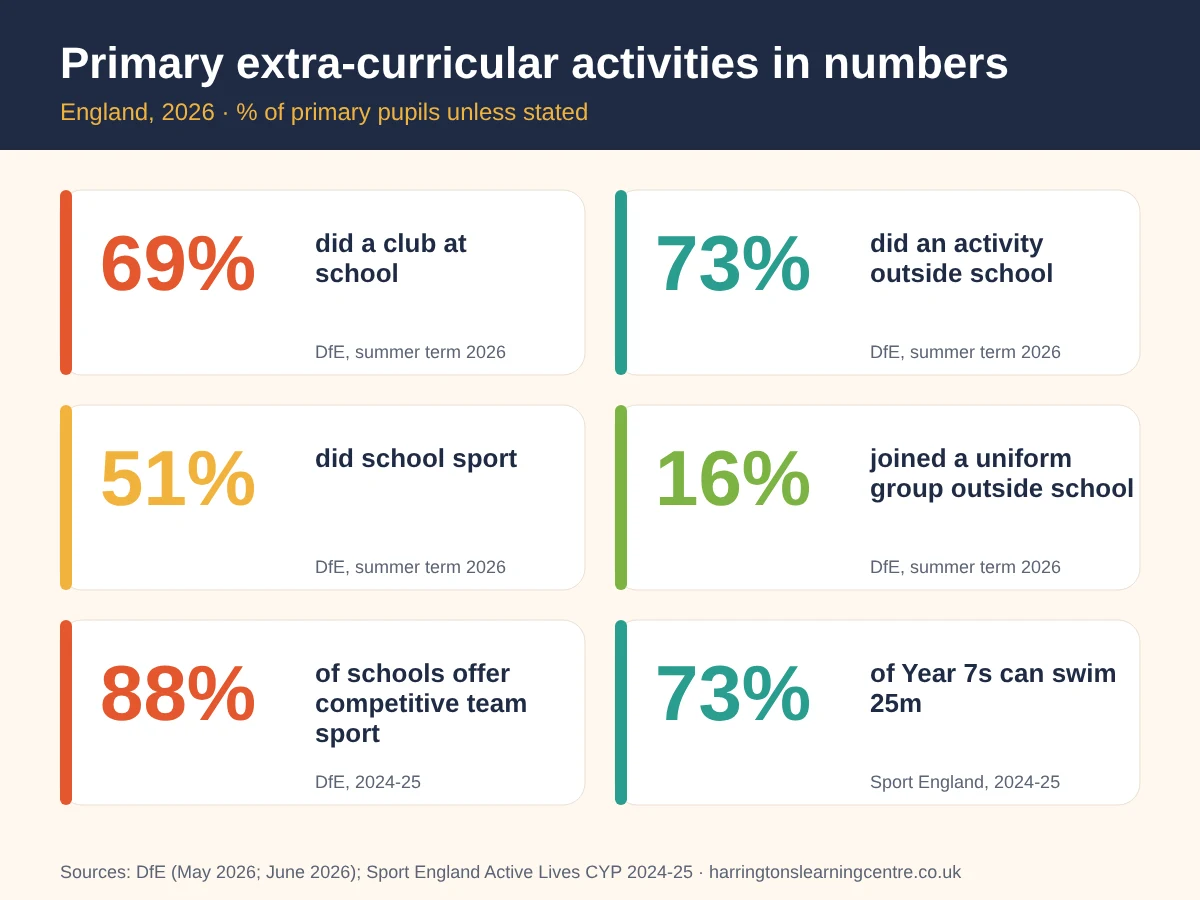
Roughly seven in ten. In the summer term of 2026, 69% of primary parents said their child took part in at least one extra-curricular activity at school, and 73% said their child did one outside school. Primary children take part more than secondary pupils (61%) and pupils at special schools (42%).
| Metric | Value | Source |
|---|---|---|
| Primary pupils in at least one school club (summer 2026) | 69% | DfE, May 2026 |
| Primary pupils in at least one activity outside school (summer 2026) | 73% | DfE, May 2026 |
| Primary pupils doing no school-based activity | 31% | DfE, May 2026 |
| Primary pupils doing no activity outside school | 27% | DfE, May 2026 |
| Primary pupils in a school club (summer 2025) | 72% | DfE, June 2026 |
| Secondary pupils in a school club (summer 2026) | 61% | DfE, May 2026 |
| Special school pupils in a school club (summer 2026) | 42% | DfE, May 2026 |
The two years of data line up: 72% of primary pupils took part in a school club in summer 2025, and 69% in summer 2026. Activities outside school, from swimming lessons to Brownies, reach slightly more children than school clubs do. Many families use both, often alongside breakfast and after-school childcare that has its own costs.
2Examples of extra-curricular activities, using the DfE's five categories
The Department for Education's enrichment framework, published on 15 June 2026, groups extra-curricular activities into five categories: civic engagement; arts and culture; nature, outdoors and adventure; sport and physical activities; and wider life and future skills. Sport is the largest by participation: 51% of primary pupils did a sports club at school in summer 2026.
| DfE category | Examples named by the DfE | Source |
|---|---|---|
| Sport and physical activities | Individual and team sports, dance, fitness, cycling, representing the school, going to live events | DfE, June 2026 |
| Arts and culture | Music, art, dance, theatre, museum and gallery visits, school productions, radio broadcasting | DfE, June 2026 |
| Nature, outdoors and adventure | Outdoor time, climate education, gardening, residentials, camps, canoeing, rock climbing | DfE, June 2026 |
| Civic engagement | Volunteering, debating, school democracy, community engagement | DfE, June 2026 |
| Wider life and future skills | Digital literacy, STEM clubs, cooking, financial management, enterprise | DfE, June 2026 |
Here are the same categories as parents report them. This is the share of primary pupils doing each type of activity in the summer term of 2026, at school and outside school.
Outside school, sport rises to 59% and performing arts sits at 19%. Academic clubs fall from 11% at school to 5% outside. Families tend to use school for clubs tied to learning and look elsewhere for sport and uniform groups. If your child enjoys a maths or reading club, free Key Stage 2 activity booklets and tests give them something similar to do at home.
3What primary schools actually offer: team sport tops the list at 88%
Almost every school runs some enrichment. A DfE review found 98% of schools offered at least one extracurricular activity in 2024-25. Competitive team sports were the most common (88%), followed by positions of responsibility such as prefect or mentor roles (79%) and musical performance groups such as choir or orchestra (75%).
| Activity type offered | Schools offering | Source |
|---|---|---|
| Competitive team sports | 88% | DfE, 2024-25 |
| Positions of responsibility (e.g. mentoring) | 79% | DfE, 2024-25 |
| Musical performance (orchestra, band, choir) | 75% | DfE, 2024-25 |
| Individual instrument or singing lessons | 73% | DfE, Dec 2024 |
| Arts, crafts and design | 70% | DfE, Dec 2024 |
| Drama and theatre | 66% | DfE, Dec 2024 |
| Academic subject clubs | 64% | DfE, Dec 2024 |
| Interest clubs | 61% | DfE, Dec 2024 |
| Games clubs | 57% | DfE, Dec 2024 |
| Dance | 56% | DfE, Dec 2024 |
These figures cover primary and secondary leaders together. The first three rows come from the 2024-25 summer wave cited in the DfE's June 2026 evidence review; the December 2024 wave put team sports at 90%.
The offer is now under closer scrutiny. The DfE framework sets eight benchmarks for a good enrichment offer, including one that is "broad and well-rounded" and one that is "accessible and engaging". The Key for School Governors reports that Ofsted will consider how schools align with the framework from September 2026, although the guidance itself is non-statutory. The framework's case studies include Ark Schools' Primary Connections Passport of 42 experiences and an 80-hour annual enrichment entitlement at Ormiston Academies Trust.
Schools also struggle to tell parents what they offer. Only 44% of primary parents in June 2025 knew of any extra-curricular arts opportunities at their child's school. If your child's school publishes a clubs list each term, add it to a printable weekly planner so sign-up dates don't slip past.
4Infants swim and dance; juniors switch to team sports
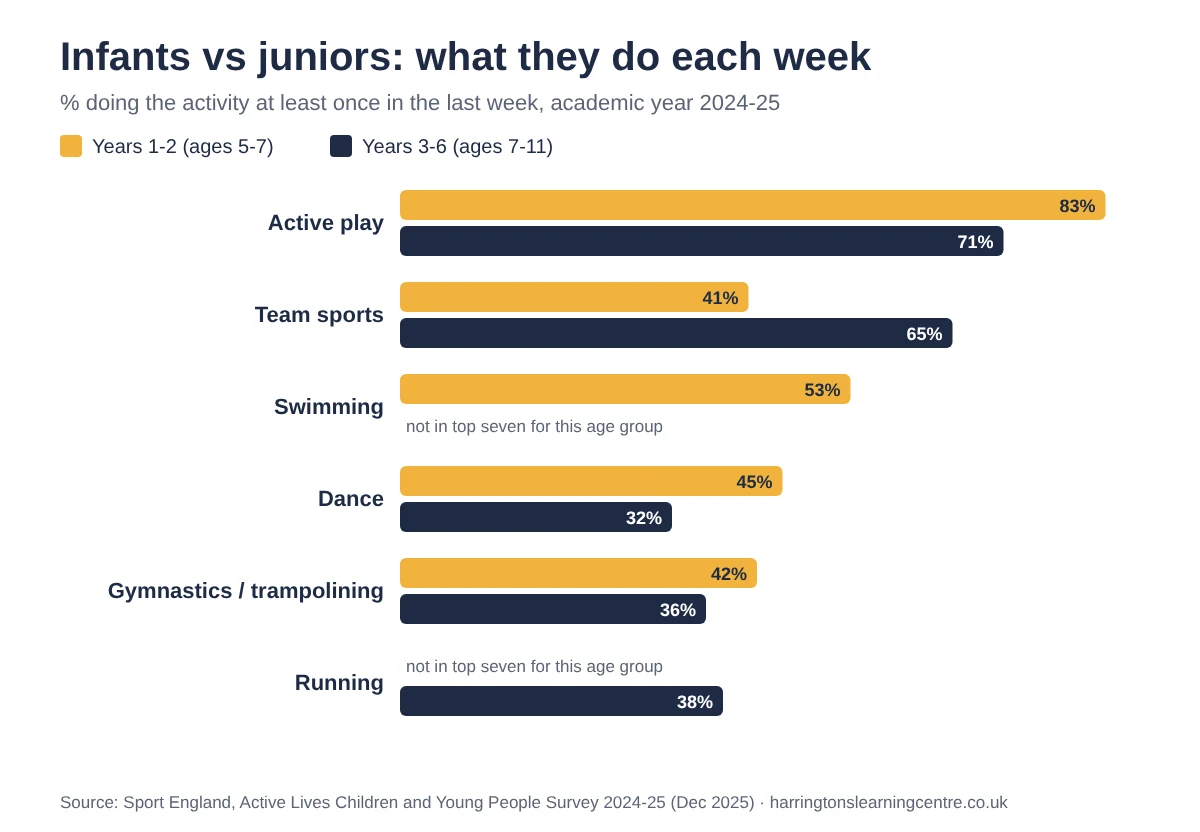
What children do changes sharply between infant and junior school. Sport England's 2024-25 survey found that swimming (53%), dance (45%) and gymnastics or trampolining (42%) feature strongly in Years 1-2. In Years 3-6, team sports jump to 65% and running, including the daily mile, reaches 38%.
| Weekly activity | Years 1-2 | Years 3-6 | Source |
|---|---|---|---|
| Active play and informal activity | 83% | 71% | Sport England, 2024-25 |
| Team sports | 41% | 65% | Sport England, 2024-25 |
| Swimming | 53% | – | Sport England, 2024-25 |
| Dance | 45% | 32% | Sport England, 2024-25 |
| Gymnastics, trampolining or cheerleading | 42% | 36% | Sport England, 2024-25 |
| Running (including the active mile) | – | 38% | Sport England, 2024-25 |
| Meeting 60 active minutes a day | 53% | 45% | Sport England, 2024-25 |
A dash means the activity was not among the seven most common for that age group in the published report.
The overall activity picture is improving slowly. In 2024-25, 49.1% of 5 to 16-year-olds met the 60-minutes-a-day guideline, and activity among Years 3-6 rose by 1.5 percentage points on the year before. For infants, clubs that feel like play work best: dance, gymnastics and swimming. Those years are also when children are learning their Key Stage 1 reading and phonics basics, so a short, active club after school can balance out a day of sitting still.
5Why parents choose clubs, and what gets in the way
Enjoyment comes first. 91% of primary parents whose child does a school club say it is because the child likes the activity. Learning new skills (62%), confidence (61%) and physical health (60%) follow. When children don't take part, the main reason is that the school offers nothing that interests them (35%), not cost (7%).
| Reason a primary child did no school club | Parents | Source |
|---|---|---|
| School doesn't offer activities that interest them | 35% | DfE, June 2025 |
| Does activities outside school instead | 33% | DfE, June 2025 |
| Child doesn't want to take part | 28% | DfE, June 2025 |
| Timings aren't practical | 9% | DfE, June 2025 |
| Activities cost too much | 7% | DfE, June 2025 |
| Child lacks confidence | 7% | DfE, June 2025 |
| Not accessible for their needs | 5% | DfE, June 2025 |
The childcare figure stands out. 22% of primary parents say school clubs partly cover before or after-school care, compared with 4% of secondary parents. If clubs are part of how you manage the working week, Ofsted-registered providers can be paid through Tax-Free Childcare, where the government adds £2 for every £8 you pay, up to £2,000 per child a year. In the holidays, eligible families can also get free HAF holiday clubs with activities and food.
When the school's list doesn't suit your child, a community setting can fill the gap. In Brierfield, our clubs and activities include the Fun Vibes creative sessions outside school hours.
6Do extra-curricular activities make a difference?
The evidence points to modest but real benefits. The Education Endowment Foundation estimates that arts participation adds about three months of academic progress and physical activity about two, both at very low cost. A UCL study of more than 6,400 English children found that disadvantaged pupils who went to after-school clubs scored 2 points higher in their KS2 assessments.
| Metric | Value | Source |
|---|---|---|
| Arts participation: average extra progress | +3 months | EEF Toolkit |
| Physical activity: average extra progress | +2 months | EEF Toolkit |
| Disadvantaged pupils at after-school clubs: KS2 total score | +2 points | UCL CLS, 2016 |
| Organised sport at ages 5, 7 and 11: chance of above-expected KS2 maths | ~1.5× | UCL CLS, 2016 |
| Primary parents reporting no enrichment in an average week | 18% | CSJ/YouGov, 2021 |
| Any enrichment in an average week: lowest vs highest social grade | 61% vs 81% | CSJ/YouGov, 2021 |
| Music participation: lowest vs highest income households | 11% vs 32% | Social Mobility Commission, 2019 |
The EEF finds the arts effect is similar for primary and secondary pupils, and tends to be stronger for writing and maths than for reading. Clubs that mix activity with learning can do double duty. A times-tables relay or a spelling bee is easy to copy at home with free maths worksheets and statutory spelling word lists.
Access is the weak point. Sport England finds 58% of children from the most affluent families meet the activity guideline, against 45% from the least affluent. The government's National Youth Strategy aims to halve the participation gap between disadvantaged young people and their peers by 2035. Habits formed now carry forward: the step up to secondary school is easier for children who already have a club, a team or a group of friends, alongside solid basics such as the work in a Year 6 to Year 7 maths transition booklet.

7Club finder: extra-curricular ideas for your child
Pick your child's stage and what they enjoy. The finder suggests activities from the DfE's five enrichment categories, with the most relevant participation figure for each.
Methodology
This guide brings together official and academic data on extra-curricular activities in primary school in England. Research was carried out on 4 October 2026. We consulted 26 sources and cite 16. Of the cited sources, 11 date from 2025 or 2026, led by the DfE Parent, pupil and learner voice survey (May 2026; primary parents, n = 874) and the DfE enrichment framework and evidence review (June 2026). Activity-by-age data comes from Sport England's Active Lives Children and Young People Survey 2024-25, which surveyed more than 100,000 children and was published in December 2025.
Older sources appear only where nothing newer exists and they are still cited by current research: the EEF Teaching and Learning Toolkit, the UCL Centre for Longitudinal Studies study (2016), the Centre for Social Justice/YouGov poll (2021) and the Social Mobility Commission report (2019). Each is dated in the text.
Limitations: DfE participation figures are reported by parents. The figures on what schools offer combine primary and secondary leaders. Sport England's year-group activity levels are read from published charts. Forum posts were used only to shape the questions below, never as data. This guide is updated after each DfE parent voice survey and each December, when Sport England publishes new Active Lives data.
Frequently asked questions
What are some examples of extra-curricular activities in primary school?
The DfE's June 2026 enrichment framework groups them into five areas: civic engagement (school council, debating, volunteering), arts and culture (choir, instrument lessons, drama, art club), nature and outdoors (gardening, residentials, camps), sport (football, netball, swimming, gymnastics, dance) and wider life skills (STEM, coding, cooking, enterprise).
What is the most popular extra-curricular activity for primary children?
Sport, by a distance. In summer 2026, 51% of primary parents told the DfE their child did a sports or physical activity club at school, and 59% said their child did one outside school. Performing arts came second, at 21% in school and 19% outside.
How many after-school clubs should a primary child do?
There is no official number. A December 2024 DfE survey found 59% of schools set no minimum time for clubs; those that did usually expected 1 to 2 hours a week. 91% of primary parents say their child takes part because they enjoy it, so whether your child is still enjoying it is a good guide.
Do extra-curricular activities improve primary school results?
Modestly, yes. The Education Endowment Foundation estimates arts participation adds around three months of progress and physical activity around two, both at very low cost. A UCL study of over 6,400 English children found that disadvantaged pupils who went to after-school clubs scored 2 points higher at KS2.
Why do some primary children not join school clubs?
In June 2025, 35% of primary parents whose child did no school clubs said the school offered nothing that interested them, 33% said their child went to activities outside school instead, and 28% said their child didn't want to. Only 7% named cost as the reason.
Can I use Tax-Free Childcare to pay for after-school clubs?
Yes, if the club is registered with Ofsted. The government adds £2 for every £8 you pay, up to £2,000 per child a year. 22% of primary parents say school clubs partly provide before or after-school childcare.
What is the DfE enrichment framework?
Published on 15 June 2026, it is non-statutory guidance that sets out five categories of enrichment and eight benchmarks for a good enrichment offer. The Key for School Governors reports that Ofsted will consider how schools align with it from September 2026.
Should my child be able to swim by the end of primary school?
Yes. The national expectation is that children can swim at least 25 metres unaided by the time they leave primary school. Sport England's 2024-25 survey found only 73% of Year 7 pupils could. Swimming is a common activity for younger children, with 53% of those in Years 1-2 swimming each week.
Sources and references
- Department for Education. "Parent, pupil and learner voice: May 2026." gov.uk. Accessed 4 October 2026.
- Department for Education. "Parent, pupil and learner voice: June 2025." gov.uk. Accessed 4 October 2026.
- Department for Education. "School and college voice: December 2024." gov.uk. Accessed 4 October 2026.
- Department for Education. "Evidence on enrichment in schools and colleges" (June 2026). assets.publishing.service.gov.uk. Accessed 4 October 2026.
- Department for Education. "The enrichment framework for schools and colleges." gov.uk. Accessed 4 October 2026.
- Department for Education. "Enrichment benchmarks." gov.uk. Accessed 4 October 2026.
- Department for Education. "Background supporting the enrichment framework for schools and colleges." gov.uk. Accessed 4 October 2026.
- The Key for School Governors. "DfE publishes new enrichment framework and benchmarks: summary." thekeysupport.com. Accessed 4 October 2026.
- Sport England. "Active Lives Children and Young People Survey, academic year 2024-25" (December 2025). Report PDF. Accessed 4 October 2026.
- Sport England. "Children's activity levels rising, but inactivity remains too high." sportengland.org. Accessed 4 October 2026.
- Education Endowment Foundation. "Teaching and Learning Toolkit: Arts participation." educationendowmentfoundation.org.uk. Accessed 4 October 2026.
- Education Endowment Foundation. "Teaching and Learning Toolkit: Physical activity." educationendowmentfoundation.org.uk. Accessed 4 October 2026.
- UCL Centre for Longitudinal Studies. "Out of school activities improve children's educational attainment, study reveals" (2016). cls.ucl.ac.uk. Accessed 4 October 2026.
- Centre for Social Justice. "A Level Playing Field" (2021). centreforsocialjustice.org.uk. Accessed 4 October 2026.
- Social Mobility Commission. "An unequal playing field: extra-curricular activities, soft skills and social mobility" (2019). gov.uk. Accessed 4 October 2026.
- HM Government. "Tax-Free Childcare." gov.uk. Accessed 4 October 2026.
Last updated: . Next review: after the next DfE parent voice survey is published.